
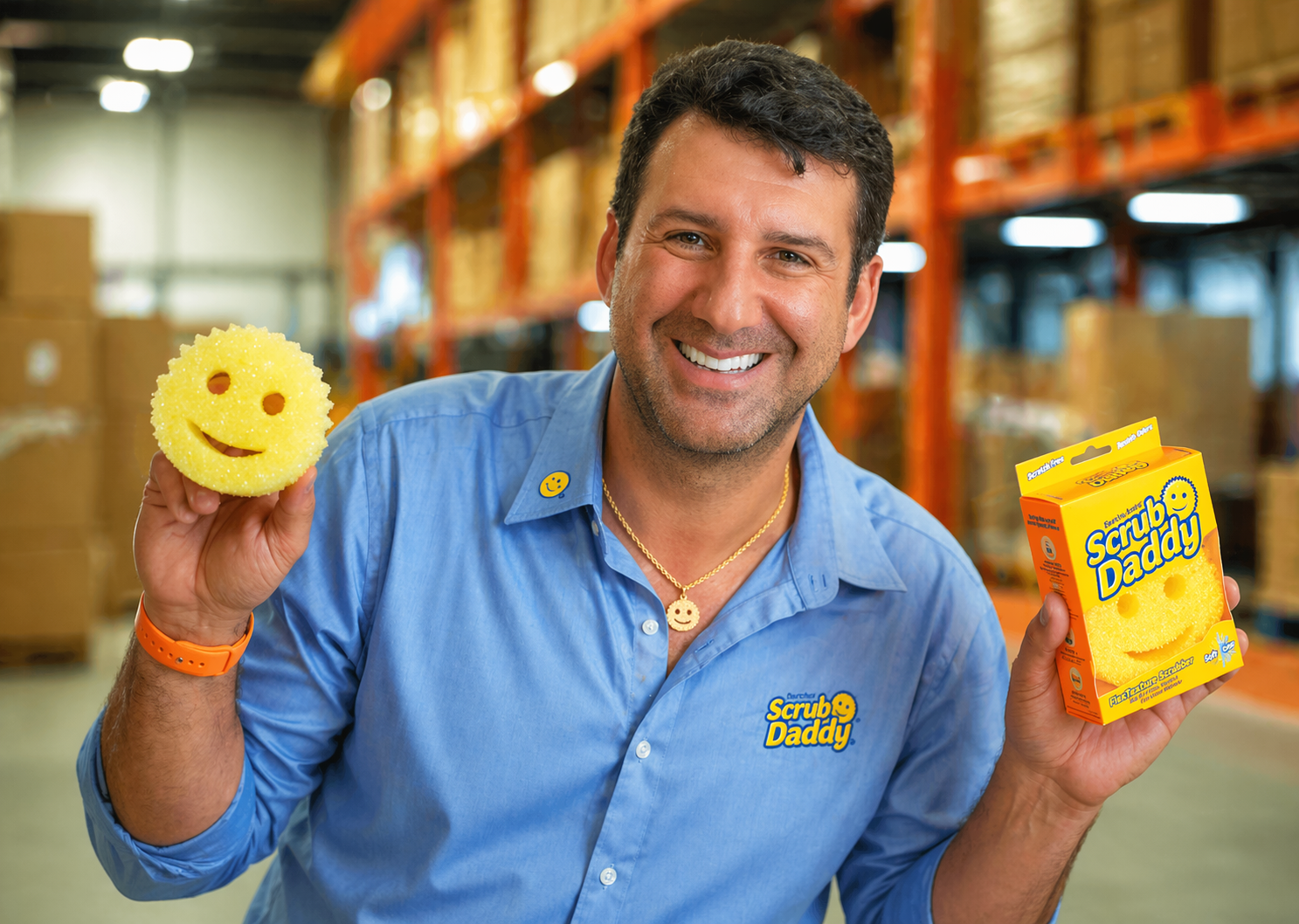
Some products become popular because they are useful. Others break through because they are clever, memorable, and easy to explain. Scrub Daddy managed to do all three, and that is a big part of why Aaron Krause’s story still stands out.
At first glance, Scrub Daddy looked like a smiling sponge with a funny face cut into it. That simple appearance made it easy to remember, but the real strength of the product was in what it could do. It changed texture based on water temperature, stayed more odor resistant than many traditional sponges, and gave people a cleaning tool that felt different from what they were used to buying. Aaron Krause did not just come up with a product that looked good on camera. He built something people could understand in seconds and appreciate after one use.
That mix of function, timing, and presentation helped turn Scrub Daddy into one of the biggest Shark Tank success stories. Aaron Krause’s rise was not built on luck alone. It came from years of trial and error, a strong eye for product design, and the ability to recognize when an old idea had a much bigger future than he first imagined.
Who Is Aaron Krause
Aaron Krause is an inventor and entrepreneur best known as the founder of Scrub Daddy. Long before the smiling sponge became a household name, he was already building products and working with materials in a hands-on way. He had experience in the buffing and polishing space, which helped him understand manufacturing, product performance, and how small design changes could make a tool far more effective.
That background mattered. Many founders fall in love with a big vision but struggle with the practical side of product development. Krause came at business from the opposite direction. He cared deeply about how things worked in the real world. His strength was not just spotting an idea, but testing whether it solved a real problem.
That problem-solving mindset runs through the whole Scrub Daddy story. It explains why he kept experimenting, why he stayed interested in materials, and why he was able to see potential in something that other people had dismissed.
The Early Idea Behind Scrub Daddy
The roots of Scrub Daddy go back to a material Aaron Krause had originally developed for another use. The foam was first tied to a hand scrubbing product, not a dish sponge meant for national retail shelves. In its early form, it was practical, but it was not yet positioned in the way the public would later recognize.
What changed everything was the realization that the foam behaved differently in warm and cold water. In cold water, it became firmer and offered more scrubbing power. In warm water, it softened and became more flexible. That made it useful across different cleaning tasks, which immediately gave it broader appeal than a standard one-texture sponge.
The design also helped the product stand out. The smile shape was not just branding. The eyes created a convenient grip, and the mouth helped clean utensils more easily. This is one of the smartest parts of the Scrub Daddy story. Krause created a product that felt fresh and fun, but the design still had a real purpose behind it.
That balance between function and personality is rare. Plenty of products are useful but forgettable. Others are eye-catching but weak in practice. Scrub Daddy gave consumers both.
Aaron Krause’s Setbacks Before the Big Break
The success story gets even more interesting when you look at how easily Scrub Daddy could have disappeared.
Before it became a breakout brand, the product was rejected and set aside. Krause had created the foam scrubber earlier, but the market he first targeted did not respond the way he hoped. The product was seen as nonessential and overpriced, which made it hard to gain traction. For many entrepreneurs, that would have been the end of the road.
Instead, the idea sat in the background. It was not gone, but it was not moving either. That quiet period became one of the most important parts of the company’s history, because it shows how often business success depends on timing and positioning rather than the product alone.
Krause later revisited the old foam and used it while cleaning outdoor furniture. That was the moment the product clicked in a new way. He saw that it worked extremely well, did not scratch surfaces, and had practical features that made it stronger than the average kitchen sponge. What had once been treated like a dead-end idea suddenly looked like a real consumer product opportunity.
That twist says a lot about Aaron Krause as a founder. He did not just persist blindly. He re-evaluated the product, noticed a better use case, and changed the way he thought about the market.
The Shark Tank Moment That Changed Everything
Even a strong product does not always become a national brand on its own. Aaron Krause needed visibility, and Shark Tank gave him exactly that.
When he stepped into the tank, he did more than present a sponge. He delivered a product demonstration that made the value obvious. That mattered because Scrub Daddy is the kind of item that sells best when people can see it in action. Krause leaned into that strength. He showed what made it different, why it worked, and why consumers would remember it.
That pitch style was a perfect match for the show. Shark Tank rewards products that are easy to understand, easy to imagine in stores, and easy to explain in a short window of time. Scrub Daddy checked every box. It was visual, useful, affordable, and broad enough to reach a mass-market audience.
The pitch led to a deal with Lori Greiner, and that became the turning point. In business stories, people often focus only on the moment a founder gets a yes. The bigger truth is that the right yes matters more than just any yes. For Krause, landing a deal with Greiner gave Scrub Daddy far more than capital.
Why Lori Greiner Was the Right Fit for Scrub Daddy
Lori Greiner was uniquely positioned to help Scrub Daddy grow because she understood demonstrable consumer products. She knew how to spot items that could win in television selling, retail placement, and broad consumer appeal.
That fit was huge. Aaron Krause had already created a product with strong visual appeal and simple selling points. Greiner brought experience, media credibility, and a distribution mindset that matched the brand. The partnership helped Scrub Daddy move from a clever product into a serious retail business.
This is one of the clearest lessons in the story. Investors are not interchangeable. The best partnership is not always the biggest check. It is the person who understands the product category, sees the same opportunity, and knows how to open the right doors.
For Scrub Daddy, those doors included major exposure, stronger packaging, retail momentum, and a much bigger stage for the brand.
How Scrub Daddy Became a Breakout Brand
After Shark Tank, Scrub Daddy had something many new consumer brands never fully achieve: instant recognition.
People remembered the smiling face. They remembered the temperature-changing texture. They remembered the demonstration. In a crowded household cleaning market, that kind of recall is powerful.
But recognition alone does not create long-term success. What kept Scrub Daddy moving was the fact that customers actually liked using it. The product had a memorable identity, but it also delivered on the promise. That helped create repeat buying, word of mouth, and stronger trust at retail.
The company also benefited from smart branding. The name was simple. The packaging was easy to spot. The visual identity felt light, upbeat, and approachable in a category that can easily look dull or interchangeable. Scrub Daddy did not try to sound overly technical. It made cleaning feel a little more enjoyable, and that helped the brand stand out.
Over time, the company moved from being known as a Shark Tank success to being known as a real player in the household cleaning space. That is an important difference. Plenty of products get a burst of attention from television. Far fewer turn that attention into lasting shelf presence and category strength.
The Business Strategy Behind Aaron Krause’s Success
Aaron Krause’s success with Scrub Daddy was not built on one lucky break. It rested on several smart business moves working together.
First, he focused on product innovation that people could immediately understand. He did not need a long explanation or a complicated feature list. The value was obvious and practical.
Second, he understood the power of demonstration. Scrub Daddy is a product that comes alive when people see it used. That made it ideal for television, home shopping, social media, and in-person selling.
Third, he built around a clear brand identity. The product looked different, felt different, and sounded different from the competition. In consumer products, that kind of clarity matters.
Fourth, the company scaled without abandoning the core appeal of the original product. Scrub Daddy did not grow by becoming generic. It grew by staying recognizable while broadening the range.
Finally, Krause stayed close to the basics of what made the brand work. At its heart, Scrub Daddy solved an everyday problem in a better and more memorable way. That foundation gave the company room to expand without losing focus.
How Aaron Krause Expanded Scrub Daddy Beyond One Product
A lot of founders build one winning product and then struggle to create anything else customers care about. Aaron Krause avoided that trap by expanding Scrub Daddy in a way that felt connected to the original brand promise.
Instead of moving too far from what consumers already trusted, the company built a broader cleaning line around the same themes: useful design, better performance, and a friendly brand personality. Products like Scrub Mommy and other extensions helped turn Scrub Daddy from a single hit into a wider cleaning brand.
That strategy matters because long-term success usually depends on more than one item. Retailers want a brand with staying power. Consumers respond well when they know what a company stands for. By building on the original identity rather than chasing random categories, Krause strengthened the brand instead of diluting it.
This is one reason Scrub Daddy became more than a TV success story. It developed into a real business with scale, retail relationships, and product depth.
What Entrepreneurs Can Learn from Aaron Krause and Scrub Daddy
There are several business lessons in Aaron Krause’s journey, and they go well beyond household cleaning products.
One of the biggest is that rejection does not always mean the idea is bad. Sometimes it means the positioning is wrong, the audience is wrong, or the timing is off. Scrub Daddy did not become a hit because the product magically changed overnight. It became a hit because Krause found the right use case and presented it the right way.
Another lesson is that demonstrability matters. Products that can be shown clearly often have an advantage in crowded markets. If people understand the benefit immediately, the path to sales becomes much easier.
Branding is another major takeaway. Scrub Daddy was not buried under confusing messaging. It looked approachable, sounded memorable, and made a routine task feel slightly more fun. That emotional edge can matter just as much as performance.
There is also a lesson in persistence, but not the empty kind people often talk about. Krause did not just keep pushing the same failed story. He adapted, rethought the product, and changed the market angle. That is a much more useful version of persistence for founders.
Aaron Krause and Scrub Daddy’s Lasting Business Impact
Today, Aaron Krause and Scrub Daddy are tied to one of the most recognizable entrepreneurial success stories to come out of Shark Tank. The company grew from a forgotten foam product into a widely distributed household brand with major retail presence, a broad product line, and international reach.
That kind of growth does not happen because a product looks clever on television. It happens when the founder understands the product, the market, the customer, and the importance of timing. Aaron Krause’s achievement with Scrub Daddy came from combining invention with execution.
His story also continues to resonate because it feels relatable. The product was simple. The problem was ordinary. The early path was messy. That makes the result even more impressive. Scrub Daddy did not rise because it tried to sound revolutionary. It rose because it solved a common problem better than most people expected.
For anyone interested in entrepreneurship, branding, product design, or consumer business growth, Aaron Krause and Scrub Daddy offer a clear example of how a small idea can become a major success when the right product meets the right presentation and the right partner.